
No products in the cart.
Corneofix® F 20 Tape Stripping & Desquamation in Clinical Research and Dermatology
- Home
- Understanding the Differences Between Skin Glow, Radiance, Brightness & Gloss
Standardized Desquamation Sampling with Pressure-Controlled Application and Quantitative Readouts
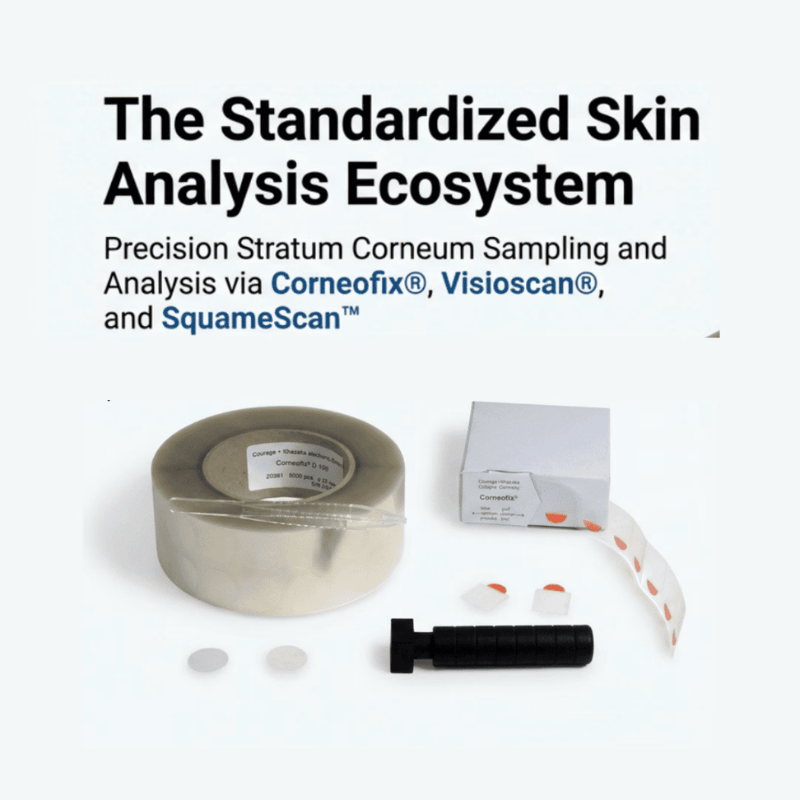
Why stratum corneum sampling still matters?
The stratum corneum (SC) is the primary interface between skin and the environment, and many clinically relevant endpoints—dryness, scaliness, irritation, barrier change, and treatment response—manifest first at the surface. For studies that require objective, repeatable surface sampling without invasive procedures, tape stripping remains a widely accepted approach.
Corneofix® F 20 is a standardized adhesive sampling format designed to collect corneocytes and superficial SC material. When paired with a pressure instrument, Corneofix sampling becomes more reproducible—an important requirement for clinical trials, multi-operator protocols, and longitudinal studies with repeated visits.

What is Corneofix® F 20?
Corneofix® is an adhesive sampling medium used to collect corneocytes (dead skin cells) and surface material from the SC. The sampled material can be evaluated in two complementary ways:
- Morphology/pattern-based evaluation of desquamation (scaling distribution, flake pattern)
- Quantitative assessment of how much SC material was removed (e.g., protein load)
Corneofix® F 20 refers to the square sampling format, commonly selected when protocols require:
➖ consistent sampling geometry
➖ strong repeatability across visits
➖ compatibility with standardized evaluation workflows
How does Corneofix® F 20 work?
1) Application (standardized contact)
The adhesive strip is applied to the selected site under controlled conditions. In research-grade protocols, a pressure instrument (pressure-aid) is used to minimize variation caused by:
- operator-dependent pressing force
- inconsistent contact across curved or uneven skin
- site-to-site variability in multi-center settings
2) Removal (sample collection) — including SquameScan™ 850A
After the defined contact time, the Corneofix® F 20 strip is removed in a controlled motion. The adhesive surface now contains collected SC material and can be processed immediately.
Option A — Imaging / morphology-based evaluation
The strip can be examined for desquamation distribution and pattern. This is useful when endpoints include visible scaling improvement, flake pattern change, or standardized desquamation scoring.
Option B — Rapid quantitative protein readout (SquameScan™ 850A
To quantify SC removal objectively, the strip can be measured using SquameScan™ 850A, which is designed to quantify stratum corneum protein content on tape strips (including Corneofix® formats). Practically, this step is ideal when you want a fast, standardized numeric result per strip and per timepoint.
Common workflow in studies:
- Place the strip into the carrier/cassette for measurement
- Measure absorption at approximately 850 nm (infrared)
- Export values into your study dataset (e.g., per subject/visit/site)
This provides an objective measure of protein load removed, which is often used as a normalization variable when comparing tape-stripping results across subjects or treatment arms.
3) Sample analysis & documentation
Depending on study objectives, Corneofix® strips can support:
- Quantitative protein load tracking (for standardization and comparability)
- Morphology/pattern evaluation (for desquamation/scaling endpoints)
- Downstream analysis (study-dependent), since many protocols retain the strip for additional examinations after the initial readout step
For documentation and auditability, protocols often include:
- standardized site mapping (template grid or clinical photos)
- time-stamped sampling logs
- consistent environmental conditions (temperature/humidity) when required
- digital export of instrument data into the study database
4) Visioscan® VC 20plus evaluation with Corneofix® F 20 (desquamation index)
For objective, operator-independent assessment of scaliness/dryness morphology, Corneofix® F 20 can be evaluated using Visioscan® VC 20plus, which supports calculation of a desquamation index based on analysis of the Corneofix sample. This is particularly valuable in efficacy studies where you need a numeric endpoint to compare baseline vs post-treatment changes and to support claim substantiation using standardized metrics rather than subjective grading.
Why combine SquameScan + Visioscan? Together they provide protein-load quantification (how much SC was removed) plus a visual desquamation pattern/index (how scaling morphology changes over time).
Clinical and research applications
Corneofix® F 20 is commonly used in protocols that require standardized surface sampling and repeat measurements, including:
Dryness and scaliness (desquamation) efficacy studies
- quantify changes in scaling over time
- compare treated vs untreated sites
- demonstrate improvement with moisturizers, barrier creams, or dermatologic regimens
Dermatology and barrier-related investigations (surface-focused)
- support studies where SC changes are primary outcomes
- track surface response to interventions, environmental conditions, or seasonal effects
Cosmetic product testing and claim substantiation
- generate objective, report-ready outcomes (protein load + desquamation index)
- support comparative studies across multiple formulations
Longitudinal monitoring and multi-visit protocols
- pressure-controlled sampling + numeric readouts improve reproducibility across timepoints
- ideal for trials requiring repeat sampling at the same anatomical region
Available sizes and shapes
Corneofix is typically available in multiple geometries to match anatomical site constraints and study design. In practice:

Key scientific benefits of Corneofix® F 20 with a pressure instrument
Non-invasive sampling suitable for repeated measures
Tape stripping targets the superficial SC and is typically well-tolerated, enabling repeated sampling without invasive procedures.
Practical scalability for clinical studies
Fast measurement steps, straightforward workflow, and standardized sampling geometry make this approach suitable for both pilot studies and larger clinical trials.
Improved reproducibility (pressure-controlled application)
Using a pressure instrument reduces operator-dependent variability, strengthening the reliability of comparisons across:
- subjects
- operators
- sites
- visits and timepoints
Stronger endpoints through complementary quantification
Combining:
- SquameScan™ 850A (protein load) and
- Visioscan® VC 20plus (desquamation index from Corneofix F 20)
creates a more defensible dataset: one metric reflects quantity removed, and the other reflects morphology/pattern change.
FAQs About Corneofix® F 20
Find answers about our instruments, services, and how to get started.
What types of products does Medelink offer?
Corneofix® F 20 collects stratum corneum material (corneocytes). From this, studies can quantify desquamation-related endpoints, including morphology/pattern-based indices and quantitative measures such as protein load.
Why use a pressure instrument with tape stripping?
Pressure-controlled application improves reproducibility by reducing operator-dependent variation, which is critical for longitudinal studies and multi-site clinical trials.
What is the difference between SquameScan™ 850A and Visioscan® VC 20plus in this workflow?
SquameScan™ provides protein-load quantification on the tape strip (how much SC material was removed). Visioscan® VC 20plus supports calculation of a desquamation index based on evaluation of the Corneofix sample (how the scaling pattern changes).
Join Our Newsletter Now
Get updates on new instruments, testing insights, and industry news delivered to your inbox.

Discover
- In-vivo Testing
- 3D Imaging
- In-vitro Testing
- Aesthetic Consultation
- Skin-On-Chip
- VITRO-SKIN®
- Allergy Testing
Resource
- Latest News
- Equipment Rental
- FAQ
- Contact
Product was successfully added to your cart!


